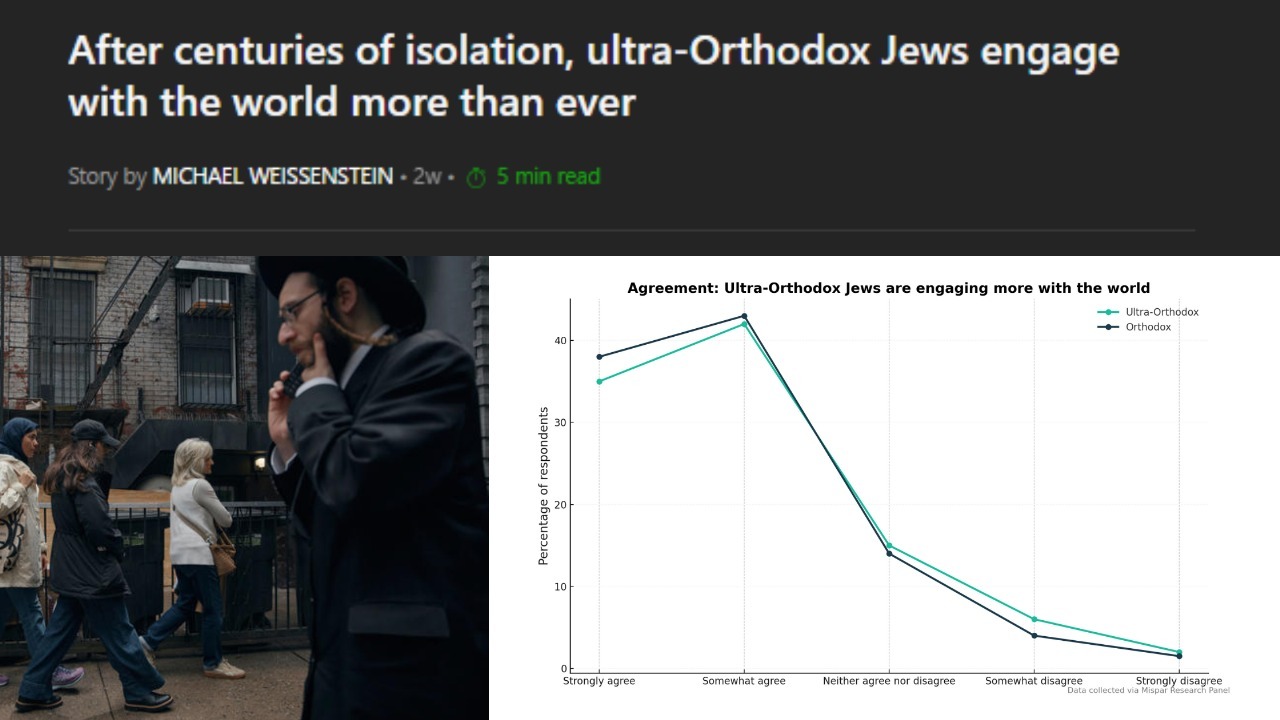
On July 1, 2025, CNN published an article claiming that “After centuries of isolation, ultra-Orthodox Jews engage with the world more than ever.” To test the validity of this claim, Mispar conducted a survey with its exclusive panel of Orthodox and Ultra-Orthodox Jewish Americans.
Within the analytical sample (n = 283), almost half (49%) resided in New York, with the remainder across 21 other states including New Jersey (16%), Illinois (4%), and Texas (3%). The sample included 142 females, 141 males, 207 ultra-Orthodox and 76 Orthodox* respondents (ages 19–72).
Agreement with Broader Engagement Claim
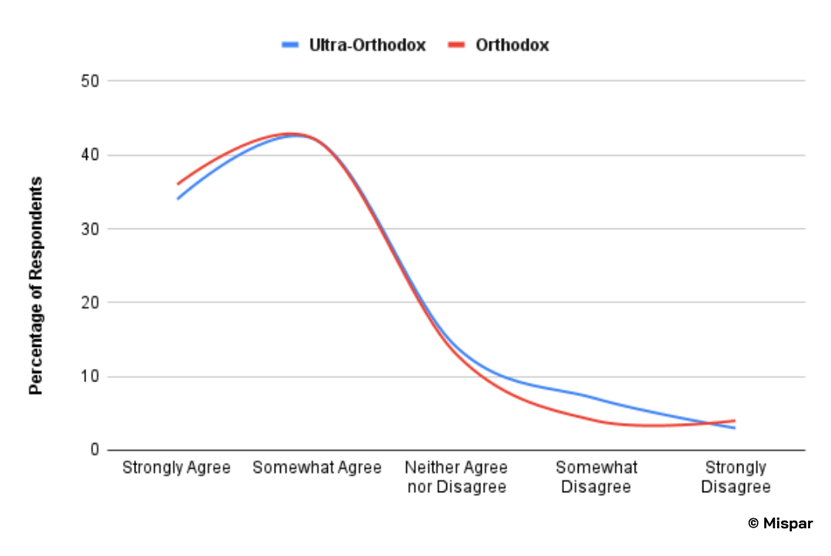
When asked: “To what extent do you agree or disagree that after centuries of isolation, ultra-Orthodox Jews are engaging with the world more than ever?”
- Over three-quarters of respondents agreed with the statement: 36% strongly agreed and 42% somewhat agreed.
- Only 9% disagreed (6% somewhat, 3% strongly). Disagreeing respondents often noted that ultra-Orthodox Jews have always engaged with the outside world. Both Orthodox and ultra-Orthodox groups expressed nearly identical agreement.
Areas of Engagement & Sentiment
When asked in which areas engagement is highest, business and commerce (71%) and technology and digital media (69%) ranked top, while education (42%) saw the least reported increase in interaction.
.png?width=790&height=516&name=%C2%A9%20Mispar%20(1).png)
Gender Differences & Coding Notes
It is worth noting that 8% of women compared to 3% of men viewed broader world engagement as mostly negative, suggesting potential gender differences in how increased engagement is perceived.
*Note: Respondents were coded as Orthodox if they self-identified as Modern Orthodox, Orthodox, or Sefardi. Respondents were coded as ultra-Orthodox if they self-identified as Chassidish, Yeshivish, or Litvish.
Join our research panel! Click this link →
Written by Esther Scheibler
Research AnalystEsther Scheibler, Ph.D. is the lead researcher at Mispar, where she specializes in uncovering meaningful insights. With a background in research methodology and community engagement, she blends rigorous methodologies with data analysis to help businesses and nonprofits navigate complex questions with clarity and confidence.