
Mispar surveyed Orthodox and Chassidish Jewish Americans to examine how frequently they eat meals outside the home, including takeout. The analysis compares eating-out frequency between Tri-State and out-of-town residents.
Methodology
We polled 145 members of Mispar’s panel of Orthodox and Chassidish Jewish Americans. All respondents were over the age of 18 and English-speaking. Participants were asked: “How often do you eat meals out (including take-out)?” The response options were measured on a 7-point ordinal scale ranging from “Daily/Almost daily” to “Never/Almost never”. Participants were recruited from Mispar’s proprietary panel, which is composed exclusively of Orthodox and Chassidish American Jews. Respondents received panel points redeemable for a Visa gift card as compensation for their time.
Findings
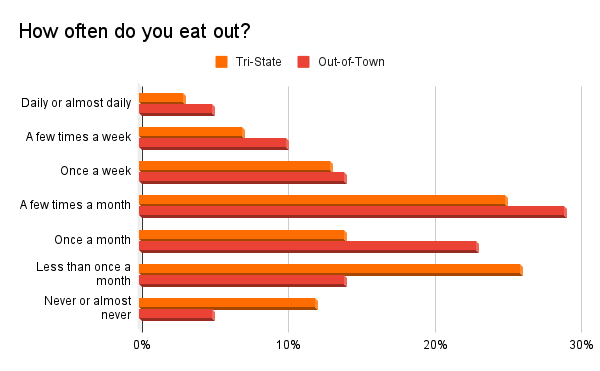
- “A few times a month” was the most commonly reported frequency of eating out.
- Tri-State area residents were more than twice as likely to report never or almost never eating out compared to respondents living outside the Tri-State area (12% vs. 5%).
Conclusion
Despite the greater availability of kosher restaurants in the Tri-State area, Tri-State respondents were significantly more likely to report never eating out. This counterintuitive pattern suggests that availability alone does not drive eating-out behavior. While additional research is needed to fully explain this difference, one possible explanation is that lower overall cost of living in out-of-town communities may leave households with more discretionary income, making eating out more accessible despite fewer kosher dining options.

Written by Esther Scheibler
Research AnalystEsther Scheibler, Ph.D. is the lead researcher at Mispar, where she specializes in uncovering meaningful insights. With a background in research methodology and community engagement, she blends rigorous methodologies with data analysis to help businesses and nonprofits navigate complex questions with clarity and confidence.